Roman Conquest Significantly Reshaped Iberian Ancestry More Than Subsequent Migrations
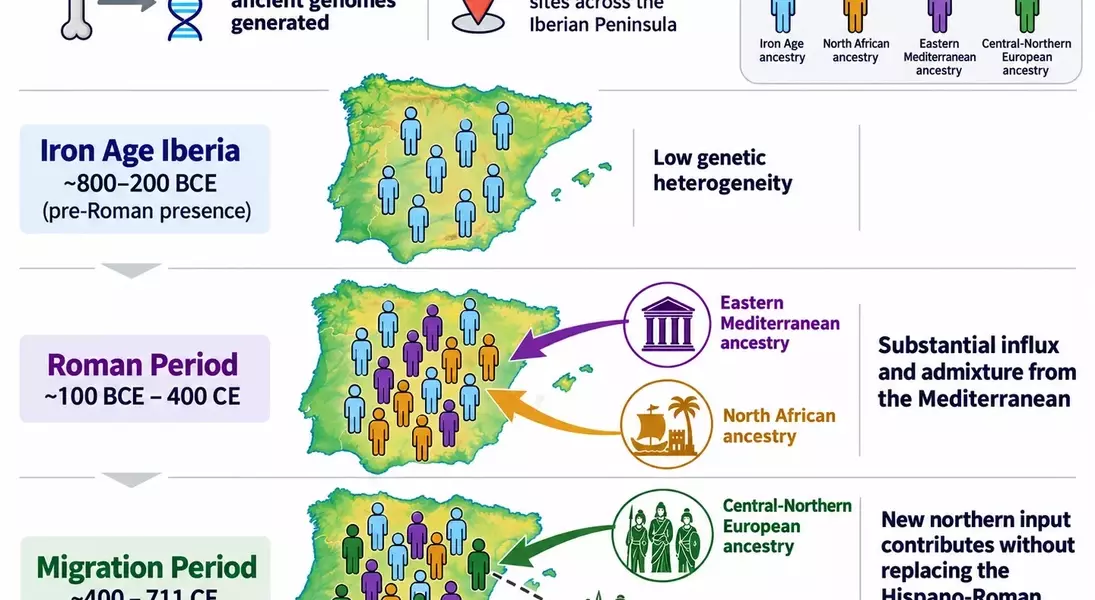
New research published in the journal Cell indicates that the Roman expansion exerted a far greater and more lasting influence on the genetic makeup of the Iberian Peninsula than the migrations that followed in the early medieval period. This groundbreaking study reveals a complex tapestry of demographic shifts, primarily driven by the arrival of Eastern Mediterranean and North African populations during Roman dominion, rather than a widespread genetic replacement during later Germanic incursions.
Roman Influence on Iberia's Genetic Landscape
The investigation, utilizing ancient DNA, found that Roman expansion profoundly altered Iberia's genetic profile. Researchers analyzed genetic data from 243 individuals who lived in Iberia between 100 and 800 CE, complementing it with findings from 58 previously studied individuals. This extensive dataset allowed for a comprehensive understanding of population dynamics during Roman rule and subsequent early medieval migrations. The analysis uncovered significant genetic contributions from the Eastern Mediterranean and North Africa, suggesting substantial movement and integration of peoples during the Roman period. This influx of diverse ancestries contributed to a notable increase in genetic variation across most of the studied regions compared to the Iron Age populations.
The study highlights that Roman rule was a crucial catalyst for demographic change in Iberia. The strategic importance and rich resources of the region attracted Roman attention, leading to profound cultural, linguistic, and legal transformations. The genetic evidence now adds another layer to this understanding, showing that Roman colonization facilitated the large-scale introduction of new genetic lineages. While direct contributions from the Italian Peninsula were less common, the widespread presence of Eastern Mediterranean and North African ancestries underscores the vast network of the Roman Empire and its role in shaping the genetic diversity of its territories. The discovery of two siblings buried hundreds of kilometers apart, sharing entirely Central-Northern European ancestry, further illustrates the remarkable mobility within the Roman infrastructure, hinting at the intricate migratory patterns of the era.
Genetic Continuity Amidst Germanic Migrations
Despite the political shifts and the arrival of Germanic groups during the 5th-century CE migration period, the study demonstrates that these later migrations had a less disruptive impact on Iberia's overall genetic continuity. While Central-Northern European-related ancestry was introduced, particularly noticeable in Germanic-associated burial sites, it did not lead to a widespread replacement of the existing Hispano-Roman population. Instead, the findings suggest a pattern of coexistence and admixture, where newcomers integrated with, rather than supplanted, the local inhabitants. This contrasts sharply with demographic changes observed in other post-Roman European regions, such as Britain, where significant population displacement occurred.
The research underlines that even with the political ascendancy of Germanic groups, the demographic impact was largely one of integration rather than eradication. Individuals with Central-Northern European ancestry lived alongside those with Hispano-Roman heritage, and evidence of genetic mixing between these groups was apparent. The persistence of North African ancestry, notably within a late antique Christian community, further emphasizes the enduring historical connections across the Strait of Gibraltar and the complex interplay of various population movements. Although Central-Northern European ancestry eventually declined, its traces into the medieval period indicate a subtle yet persistent influence. Future research, integrating ancient DNA with mobility-related isotopic analysis and broader genomic sampling, will further illuminate the intricate history of population movements and their long-term genetic consequences in Iberia and beyond.