Norris's Adaptability Key to McLaren's US GP Strategy
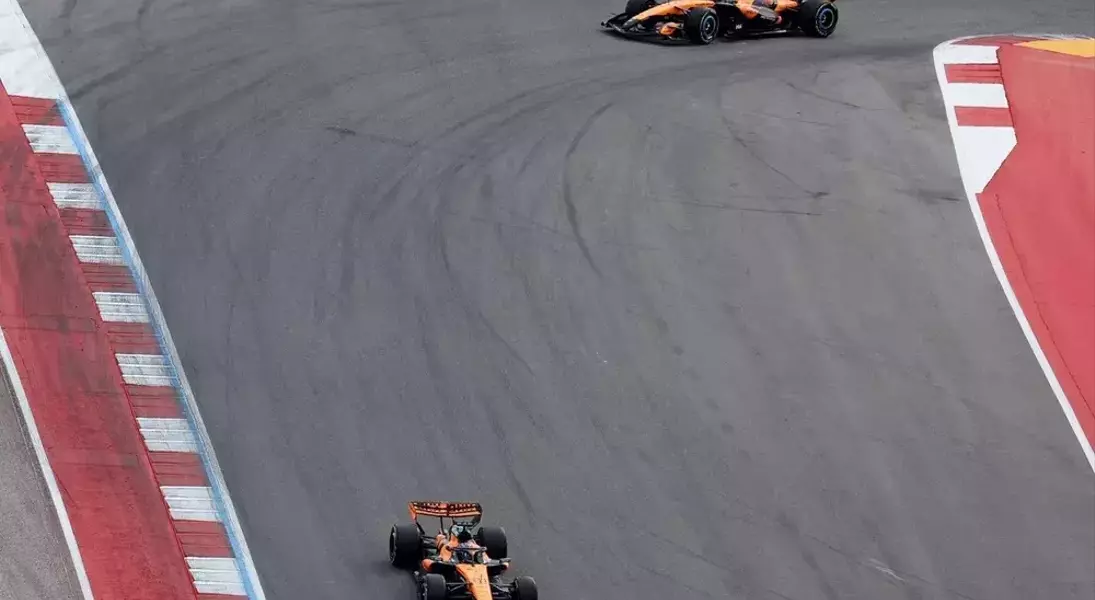
In a recent Formula 1 event, McLaren's strategic call to have Oscar Piastri yield position to Lando Norris at the United States Grand Prix stirred discussion. This decision was rooted in Norris's remarkable ability to adapt to varying track conditions, particularly those presented by the Circuit of The Americas, which proved more challenging for his teammate, Piastri. The team's principal, Andrea Stella, shed light on the rationale, emphasizing the collective goal of advancing McLaren's competitive standing.
Insight into McLaren's Strategic Race Dynamics at COTA
The United States Grand Prix saw McLaren drivers Oscar Piastri and Lando Norris begin the race from the fourth row, struggling to match the pace of competitors from Mercedes, Red Bull, and Ferrari during the qualifying rounds. Early in the race, it became evident that Piastri was losing significant time, approximately one second per lap, to the leading vehicle driven by Kimi Antonelli, and was unable to keep pace with George Russell. This prompted Norris to express his concerns over the radio about being held back. Consequently, on the eighth lap, McLaren instructed Piastri to allow Norris to pass in Turn 1, a move that quickly saw Norris gain a four-second advantage over the next seven laps.
Andrea Stella, McLaren's team principal, detailed that this strategic decision was based on observations throughout the weekend indicating Norris's faster pace, especially on the Circuit of The Americas—a track where Norris consistently performs well, unlike Piastri, who faces greater challenges. Stella noted that while Piastri excels at building consistent performance once he establishes track references, COTA's ever-changing conditions, particularly its slippery nature, better suited Norris's adaptive driving style.
This pre-race discussion and subsequent action underscored McLaren's commitment to prioritizing team interests, a principle reinforced following a collision between their drivers in the Singapore sprint race. The team aims for both drivers to secure front-row positions and contend for victories, fostering internal competition only after achieving a strong collective presence at the forefront of the grid.
McLaren opted for a single-pit-stop strategy at the US GP to challenge rival teams, particularly the Ferraris and Max Verstappen, who were on a two-stop plan. Despite Norris maintaining second place until lap 46 before being overtaken by these drivers, he still managed to secure fifth position by strategically undercutting Isack Hadjar and Russell. Piastri also outperformed Russell, finishing seventh. Stella expressed satisfaction with the strategy and the car's improved performance due to recent upgrades, acknowledging the need for further enhancements in qualifying and overall car development to consistently vie for podium finishes and wins. McLaren is currently experiencing a four-round podium drought, their longest since early 2024.
The strategic maneuvering by McLaren at the United States Grand Prix offers a compelling lesson in team dynamics and adaptive leadership within high-stakes environments. It highlights the importance of recognizing individual strengths and weaknesses, tailoring strategies accordingly, and maintaining a unified vision for collective success. This approach, prioritizing team objectives over individual pride, is crucial for sustained competitive advantage and can inspire organizations beyond the racetrack to leverage diverse talents for common goals.